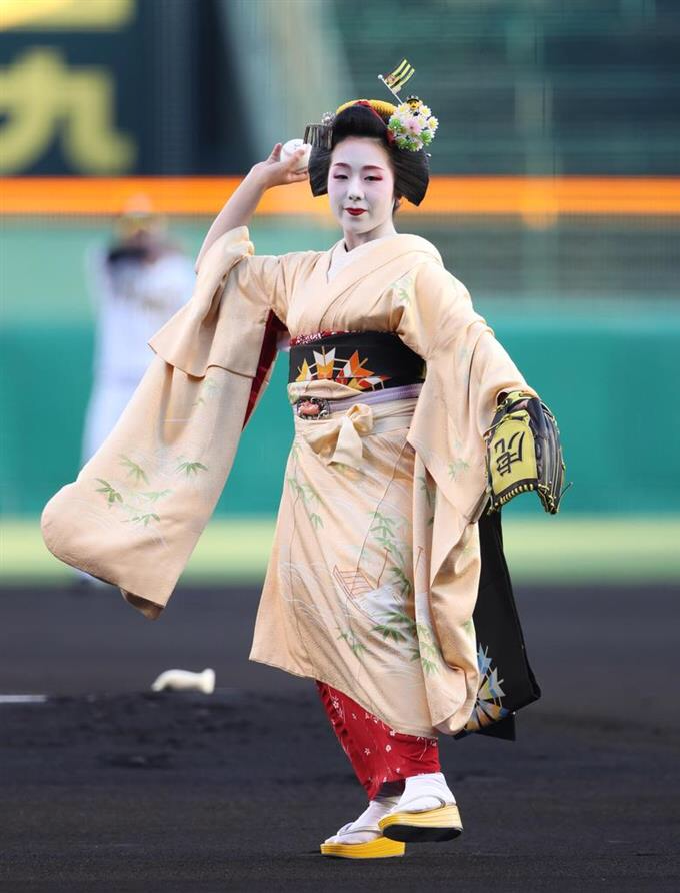
May 22, 2019 — in Japan, at a baseball game at Koshien Stadium
between Hanshin and Yakult, a maiko-san threw the opening pitch.
It was a dreamy scene as her light orange kimono fluttered through the
air. The ball bounced once and landed in the catcher’s mitt.
The batter
swung and a strike was called.
Although the ceremonial first pitch is an American export, Japan has
embraced it to its fullest. And there’s an element to it that’s uniquely
Japanese.
The ritual is said to have originated in 1892 when, “Governor McKinley threw the ball into the diamond” from his seat,
rather than the mound as is custom today. The pitch went on to evolve
as an event between the pitcher and catcher. There was no batter.
In Japan however, the ritual involves the batter, who is always supposed to swing and miss on purpose.
Japan’s ceremonial first pitch dates back to 1908
when the Reach All-Stars, the first professional team from the United
States to tour Japan, came on a promotional junket. It was a big deal.
The noble statesman Okuma Shigenobu
was to throw the first pitch. As former Prime Minister, founder of
Waseda University, it’s hard to overstate how symbolic and important a
figure he was. In what was surely a distressful nomination, Shoji Yamawaki, the top batter in the Waseda Baseball Club, was chosen to bat.
No one will know what was going through Yamawaki’s head as the former
Prime Minister and perhaps the greatest nobleman he ever faced off
with, threw the ball towards him and it hit the ground, rolled and
stopped. According to some records, several American players began rushing
towards the ball to pick it up. But that would mean an incredible
failure and embarrassment for Okuma and Yamawaki couldn’t let that
happen. So he swung his bat, a strike was called and the crowd cheered.
Since then, it’s always been customary for the batter to swing and miss
on purpose.
Created in 1983, The Wooden Floor is a nonprofit organization that annually gives 375 underserved local youth the tools to live fuller, healthier lives through a unique approach grounded in dance. They make a long-term investment in each of these young people. They engage in intensive dance education supported by academic and family services that change the way they make decisions, helping them to discover and pursue their potential.
Since 2005, 100 percent of their young artists graduate from high school on time and go on to pursue higher education. This is about three times the national average for their socio-economic peers.
Created in 1983, The Wooden Floor is a nonprofit organization that annually gives 375 underserved local youth the tools to live fuller, healthier lives through a unique approach grounded in dance. They make a long-term investment in each of these young people. They engage in intensive dance education supported by academic and family services that change the way they make decisions, helping them to discover and pursue their potential.
Since 2005, they are proud that 100 percent of their young artists graduate from high school on time and go on to pursue higher education. This is about three times the national average for their socio-economic peers.
Tonight's program to give sponsors a sneak peak into their approach to dance-making,
including questions and answers with young cast members, studio performances, and Choreographer, Mark Haim and Artistic Director, Melanie Rios Glaser.
This is a group I support. I am impressed by their dedication & total support for students.
I look forward to their Annual Spring Concert ...
dynamic energy, movement, color ... pure eye and soul candy!